Showing posts with label hiroshige ando. Show all posts

Monday, March 2, 2009

welcome to brittany


well, i should have turned left, going south towards france's west coast, instead of right, which sent me towards the north. brittany, home to gauguin and the nabis, rather than giverny, home of monet and the impressionists.

additional american (and other) artist colonies sprang up on the breton coasts, just as they had in giverny, and though there are conflicting reports as to whether dow and gauguin (who moved further away when so many americans arrived) worked together or never met, dow spent several summers in pont-aven.

while it was easy to see the jap- anese influence on the impres- sionists developing further north, from dressing their models in kimonos with parasols to the frequent diagonal structure, it was the artists in brittany that felt the japanese inspiration on another level.

painters from around the world spent time in the pont-aven region. when dow was there, he hung out with benjamin harrison, arthur hoeber, and charles 'shorty' lazar. the paintings of the breton group of painters "showed an overall simplification, a highly expressive use of colour, and an intensely spiritual subject matter."

the americans, and the other painters in the region, including the nabis, found inspiration for these leanings in the japanese prints then flooding france. dow himself took further inspiration from the nabis, whose style and philosophy involved the stripping away of irrelevent details, the flattening of space, and an indulgence in color.

the spiritual underpinning of all this involved the seeing of the direct thing, its essential nature, the idea of it. and of course once we get into ideas, of anything, we must include the artist himself, for we are now discussing personal perception.

i could begin to list all of the americans who returned to the US from brittany, having imbibed much of the same set of values just as i could list all of the europeans they encountered there, but i'd rather deal with them in an ongoing way when i get past this lengthy chapter.

instead, i want to look at the differences at the hearts of these two communities, the differences between gauguin and monet. in both cases we are talking about light, and about the approach to abstraction, modernism: monet shattered the light while gauguin worked toward sweeping away everything but light and color.

monet's philosophy was this: I want the unobtainable. Other artists paint a bridge, a house, a boat, and that's the end. They are finished. I want to paint the air which surrounds the bridge, the house, the boat, the beauty of the air in which these objects are located, and that is nothing short of impossible.

gauguin, instead, looked for something more internal; to him, going to brittany represented a return to nature in its purer form, closer to the earth itself, than existed in the rest of france. he wanted truth.

robert hughs, of time magazine, has written of gauguin, If there is an absolute originality in Gau- guin, it lies in his color, for which no amount of reproduction prepares you. It is saturated, infinitely subtle, full of the stateliest assonances and most risky contrasts; its range of emotional suggestion is immense. 1

and, Unlike the Impressionists, Gauguin did not paint what he saw: he chose to see what he wanted to paint. And his ideas on what was paintable grew out of other art—from the broad color patches and rhythmic line of Japanese cloisonne and wood block prints, from rural Breton sculpture and the flattened, monumen- tal figures of a French artist he greatly admired, Puvis de Chavannes. Style absorbed him — the pervasive feedback of art style into nature. Even the fierce colors which scandalized some of his contemporaries were meant to be remote from nature." 2 and still, a man of deep spirituality.

two artists, two schools of artists, both on a search for truth (what else is there?), one by exploding illusion, the other by scraping it away. two paths leading to the same point. i find it unsurprising, given what we've learned about dow, the man, which route he chose.

Tuesday, February 17, 2009

M O O N R I S E

AUGUST MOONRISE

The sun was gone,
and the moon was coming
Over the blue Connecticut hills;
The west was rosy,
the east was flushed,
And over my head
the swallows rushed
This way and that,
with changeful wills.
I heard them twitter and watched them dart
Now together and now apart
Like dark petals blown from a tree;
The maples stamped against the west
Were black and stately and full of rest,
And the hazy orange moon grew up
And slowly changed to yellow gold
While the hills were darkened, fold on fold
To a deeper blue than a flower could hold.
Down the hill I went, and then
I forgot the ways of men,
For night-scents, heady, and damp and cool
Wakened ecstasy in me
On the brink of a shining pool.

O Beauty, out of many a cup
You have made me drunk and wild
Ever since I was a child,
But when have I been sure as now
That no bitterness can bend
And no sorrow wholly bow
One who loves you to the end?

And though I must give my breath
And my laughter all to death,
And my eyes through which joy came,
And my heart, a wavering flame;
If all must leave me and go back
Along a blind and fearful track
So that you can make anew,
Fusing with intenser fire,
Something nearer your desire;
If my soul must go alone
Through a cold infinity,
Or even if it vanish, too,
Beauty, I have worshipped you.

Let this single hour atone
For the theft of all of me.

Sara Teasdale


© Sara Teasdale 1920
from Flame and Shadow; Macmillian, 1920

Sunday, February 15, 2009

dow's COMPOSITION part 1

i will jump right in, giving you a taste of the book that changed art education in america for at least half a century. dow's teaching philosophy involved using examples from other artists, not his own. when i can find it i will show the original on which his example is based.

The designer and picture-painter start in the same way. Each has before him a blank space on which he sketches out the main lines of his composition. This may be called his Line-idea, and on it hinges the excellence of the whole, for no delicacy of tone, or harmony of color can remedy a bad proportion.

A picture, then, may be said to be in its beginning actually a pattern of lines. Could the art student have this fact in view at the outset, it would save him much time and anxiety. Nature will not teach him composition. The sphinx is not more silent than she on this point.

He must learn the secret as Giotto and della Francesca and Kanawoka and Turner learned it, by the study of art itself in the works of the masters, and by continual creative effort.

If students could have a thorough training in the elements of their profession they would not fall into the error of supposing that such a universal idea as Beauty of Line could be compressed into a few cases like the "triangle," "bird's-wing," "line of beauty," or "scroll ornament," nor would they take these notions as a kind of receipt for composing the lines of pictures.

Insistence upon the placing of Composition above Representation must not be considered as any undervaluation of the latter. The art student must learn to represent nature's forms, colors and effects ; must know the properties of pigments and how to handle brushes and materials. He may have to study the sciences of perspective and anatomy.

More or less of this knowledge and skill will be required in his career, but they are only helps to art, not substitutes for it, and I believe that if he begins with Composition, that is, with a study of art itself, he will acquire these naturally, as he feels the need of them. Returning now to the thought that the picture and the abstract design are much alike in structure, let us see how some of the simple spacings may be illustrated by landscape.

No. 34 is a landscape reduced to its main lines, all detail being omitted. Make an enlarged copy of this, or design a similar one. Then, in the attempt to find the best proportion and the best way of setting the subject upon canvas or paper, arrange this in rectangles of varying shape, some nearly square, others tall, others long and narrow horizontally as in No. 35. To bring the whole landscape into all these will not, of course, be possible, but in each the essential lines must be retained.

The art of landscape painting is a special subject, not to be treated at length here, but I believe that the true way to approach it is through these or similar exer- cises. First study the art, then apply it, whether to landscape or any other kind of expression.

Saturday, April 5, 2008

let evening come

'Twas such a little -- little boat
That toddled down the bay!
'Twas such a gallant -- gallant sea
That beckoned it away!

'Twas such a greedy, greedy wave
That licked it from the Coast --
Nor ever guessed the stately sails
My little craft was lost!

© 2008 Emily Dickinson

Adrift! A little boat adrift!
And night is coming down!
Will no one guide a little boat
Unto the nearest town?

So Sailors say -- on yester- day --
Just as the dusk was brown
One little boat gave up its strife
And gurgled down and down.

So angels say -- on yesterday --
Just as the dawn was red
One little boat -- o'erspent with gales --
Retrimmed its masts -- redecked its sails --
And shot -- exultant on!

© 2008 Emily Dickinson


Let the light of late afternoon
shine through chinks in the barn, moving
up the bales as the sun moves down.

Let the cricket take up chafing
as a woman takes up her needles
and her yarn. Let evening come.

Let dew collect on the hoe abandoned
in long grass. Let the stars appear
and the moon disclose her silver horn.

Let the fox go back to its sandy den.
Let the wind die down. Let the shed
go black inside. Let evening come.

To the bottle in the ditch, to the scoop
in the oats, to air in the lung
let evening come.

Let it come, as it will, and don't
be afraid. God does not leave us
comfortless, so let evening come.

© 2008 Jane Kenyon

Monday, June 11, 2007

towards less obscure....

a book i took out of the library today (great photographers--a time-life book, published in 1971) says this about the photo to the right:

'[clarence h.] white's preference for unassuming subjects is seen in this view of his home town, newark, ohio. with meticulous care, he creates a still life of geometric patterns, exaggerating the foreground for effect and cropping the width of the print to accentuate the tall, skinny telephone poles.'

ummm....

for some reason, there still seems to be very little recognition of the obvious japonisme in photographs, even when they are readily acknowledged in woodblock prints.

clarence h. white learned his style from arthur wesley dow; while the japanese prints themselves were hitting europe, it was dow who brought the design philosophy to americans.


gertrude kasebier studied with dow as well, and, obviously, in the same place.


as did margaret jordan patterson.


isn't it fascinating to note that what is so obvious to many of us now could have been so obscure as recently as 1971.

there will be a lot more on this, some wonderful photos.

Sunday, November 12, 2006

the coburn and the dow

it's difficult for our eyes to even see it now, but the transition in art from depicting the literal to depicting the subjective was wildly revolutionary (as we've already seen). and this goes for photography as well as painting. for many years after their introductions both painting and photography were 'required' to reflect reality 'accurately.' at least that was true in the west.

in japan, it was different. it was just understood that the reality the artist produced was what he made of it. when arthur wesley dow suddenly realized this, supposedly while reading a book on japanese prints at the fine arts museum library in boston, it changed his work forever. he felt that this is what he had been looking for, what his work had been needing. dow realized that he did not want to be copying the prints, something he came to criticize whistler for doing, but rather creating his own style using the principles he had learned from viewing the japanese work.

it is our loss that dow spent far more time teaching, from his school in ipswitch to columbia, to the pratt institute in new york, with many stops in-between, than he did making art, and yet he bequeathed us the wonders of the work of his students.
one student, alvin langdon coburn, wasn't a true beginner when he came to ipswitch in 1903. (he would go


on to begin to photograph many of the 'men of mark' in europe the following year). he and dow became more than strictly student and teacher, as they twice went to the grand canyon together to shoot photographs, or paint.

coburn said of dow's ipswich school, "we were taught painting, pottery, and woodblock printing, and i also used my camera, for dow had the vision, even at that time, to recognize the possibilities of photography as a medium of personal artistic expression. i learned many things at his school, not least an appreciation of what the orient has to offer us in terms of simplicity and directness of composition....i think that all of my work has been influenced to a large extent and beneficially by the oriental background, and i am deeply grateful to arthur dow for this early introduction to its mysteries." the world was learning this from the japanese artists who, until being 'taught' otherwise by the westerners they were so enthusiastically trying to emulate, did not make a distinction between 'crafts' and 'art.' in europe the nabis embraced this philosophy (more on this later); additionally part of this was establishing photography's place as a fine art as well.

many thanks to pinholeman for turning me on to coburn!!

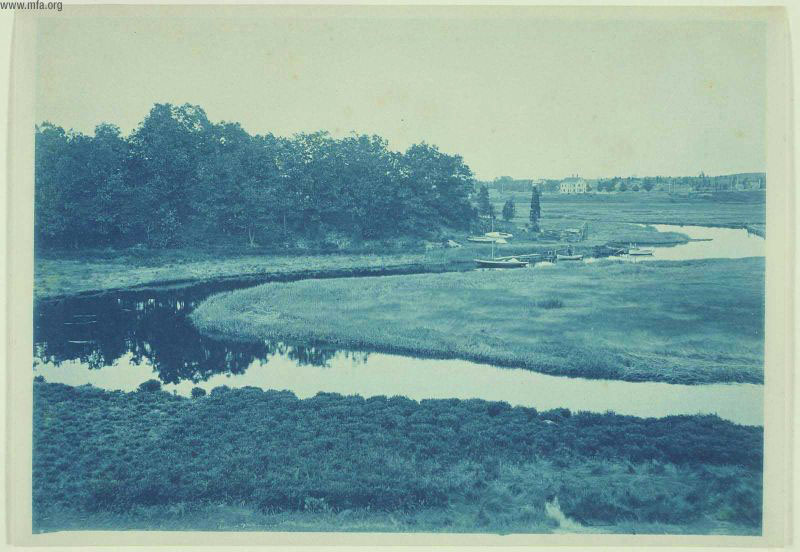
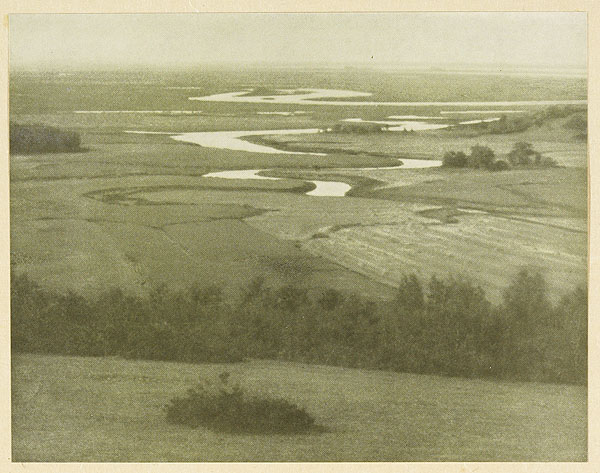
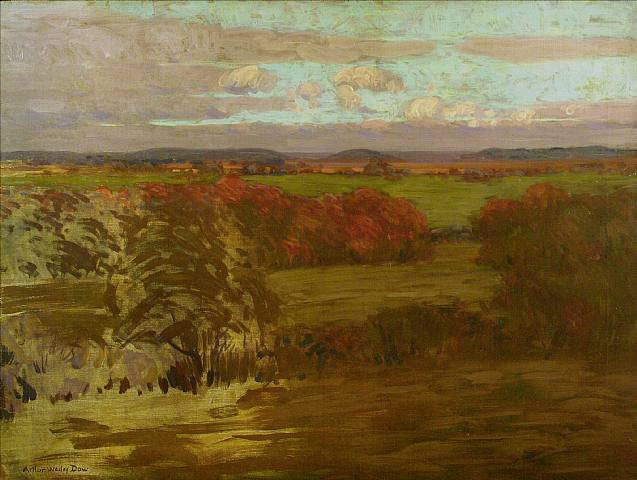
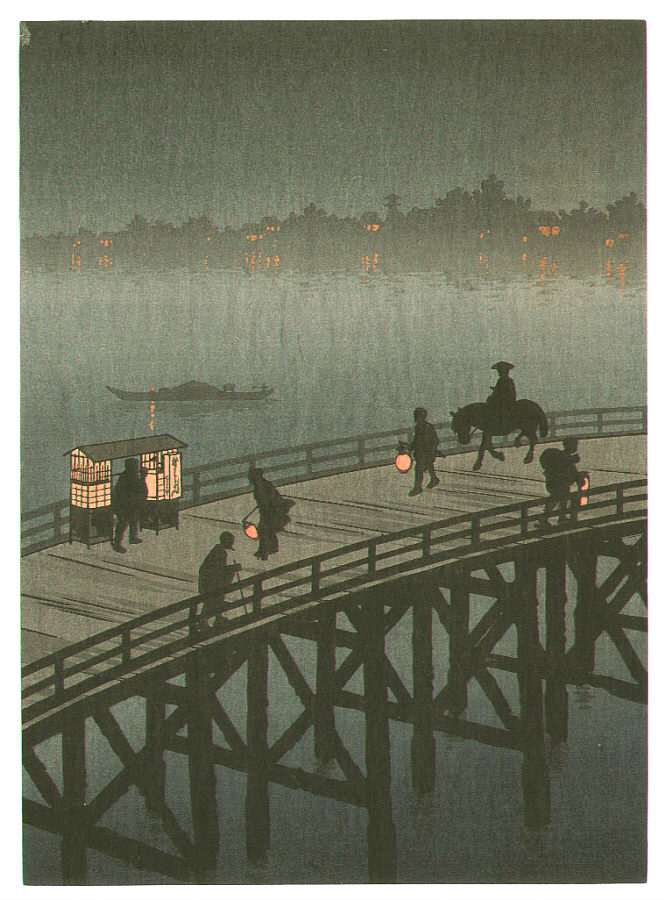
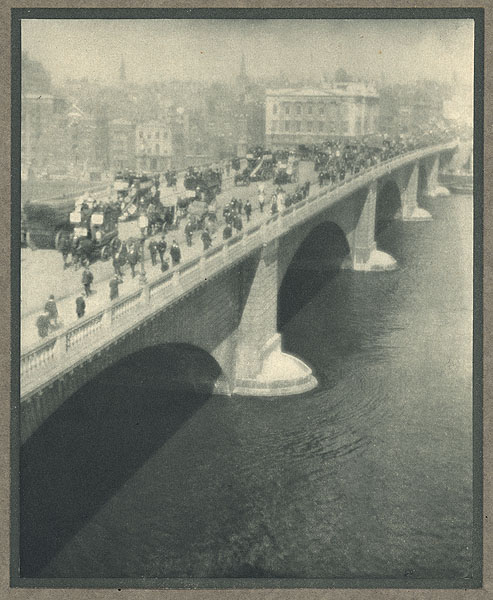
picture info: top right: 'salt marsh' dow; top left: 'moon over cherry trees' hiroshige. 2r: 'the blue dragon' dow's painting of the scene out his studio door; 2l: 'the dragon' coburn's photo of the same spot. (here i've stuck in dow's 'ipswitch meadows' because it struck me that this was essentially the same painting as his 'grand canyon'!) 3r: 'grand canyon' dow; 3l: 'grand canyon' coburn. 4l: 'oh-hashi bridge' koho shoda; 4r: 'london bridge' coburn.